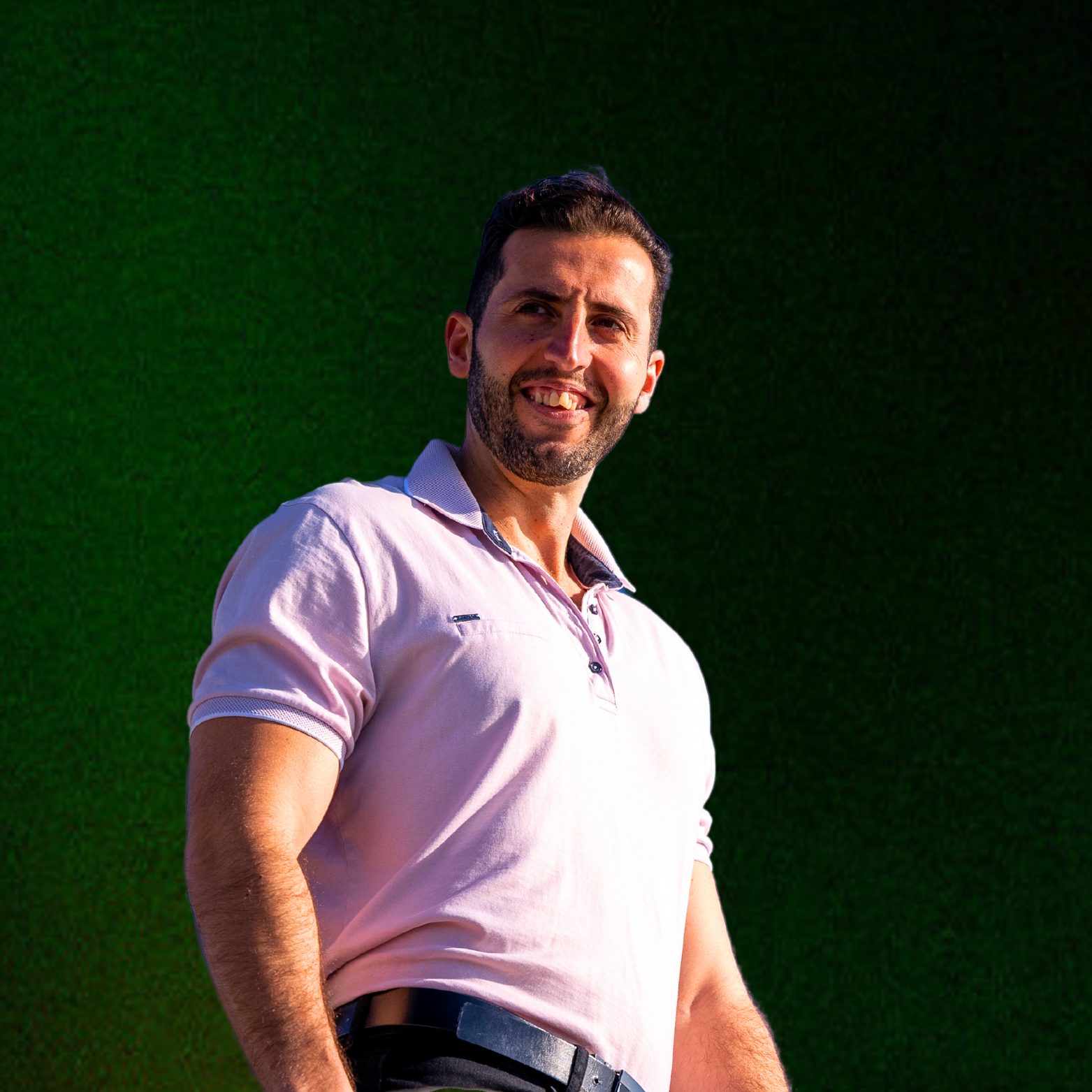
It's tempting to write a clean origin story where one person invents a method, names it, and turns it into a school. That's not what happened with the Quantum Key Method.
The QKM was developed by both brothers — Jacob and Luke Stringa — over years of working with their own clients in different modalities and comparing notes constantly. Neither brother has a clean "moment of invention" anyone can point to. The framework crystallised slowly out of hundreds of conversations between them about what was actually moving clients in their respective sessions.
This piece is the longer story of how that came together.
Two parallel practices.
Before Quantum Key Institute existed, both brothers were already doing the work, just from different angles.
Luke had moved through mechanical engineering, then IT, then trained as a coach and a hypnotherapist. He was running an online practice working with clients on coaching, identity work, and subconscious reprogramming through hypnotherapy. He was watching, session by session, what shifted clients at a level talk-based coaching couldn't reach.
Jacob had been working with clients through breathwork, energy work, hypnotherapy and meditation for years. People who'd sit with him would come out describing experiences they couldn't quite put into words. He'd trained in multiple breathwork lineages, in hypnotherapy, in energy work across several schools, and in meditation traditions including time in long silent retreats.
Two brothers. Two practices. Both brothers working with clients at the level underneath behaviour — just through different doorways.
The conversations.
They talked all the time. Catching up over the phone after sessions. Comparing what they'd seen in their respective rooms. The conversations weren't strategic at first. They were just two practitioners in the same family describing the patterns they were noticing.
What kept coming up was the same thing from different angles. No single modality was the full answer. Each one held part of the truth. Each one missed pieces another one had. A client who needed subconscious reprogramming through hypnosis often also needed somatic release through breathwork. A client who needed nervous system regulation through breath often also needed the identity work coaching does well. The boundaries between modalities were artificial — clients didn't show up with problems that fit neatly inside one box.
Over a few years a coherent picture emerged from those conversations. A framework for reading what level a client was operating at, what intervention the system was actually asking for, and how to sequence the modalities so they reinforced each other rather than cancelled out.
What started to crystallise.
If you ask either of them, the moment the QKM started becoming something they could teach was when they could articulate three things clearly together:
One. Most modalities try to change behaviour. Real client change usually requires shifting something one level deeper — the identity that's producing the behaviour. If you only change the behaviour, the identity pulls it back. If you change the identity, behaviour shifts on its own.
Two. The body holds the information before the mind has access to it. A client's words tell you what they think the problem is. Their breath, their nervous system, their posture, the small involuntary shifts when you ask certain questions — that's where the actual problem lives. Work that doesn't include the body misses most of the data.
Three. Different parts of a pattern are held at different levels. Some need cognitive work. Some need somatic release. Some need nervous system regulation. Some need subconscious access. A skilled practitioner reads where a pattern lives and chooses the intervention that fits that level.
Those three principles, plus a sequencing logic that grew out of hundreds of joint observations, is essentially what the QKM is.
From private practice to formal modality.
For years the work stayed in their private practices. Both brothers had steady caseloads. They weren't trying to scale anything. The shift came when Luke started working on the business side of established coaches' practices. He kept seeing the same gap from the inside — brilliant practitioners with no business behind them, certifying through one school after another and still going broke.
Jacob was watching the same gap from the other side — people training in breathwork or hypnotherapy at one school, learning the technique, and leaving with no framework for integrating it with anything else, and no business model for actually running a practice.
The brothers had been talking about a school for a long time. The decision to actually build it came when it became clear that the gap wasn't going to fix itself, and that the QKM — the framework they'd both been refining together for years — was the integrating layer that the industry was missing.
The name "Quantum Key Method" came late in the process. The work had existed for years without a label. Naming it formally meant being able to teach it — to give the framework to other practitioners who could then use it in their own rooms.
How the work is taught now.
Inside the QKI curriculum, both brothers co-lead the QKM teaching. Jacob holds the practitioner side — the deeper modality work, breathwork facilitation, energy work, hypnotherapy, the in-room teaching. Luke holds the business side and the Business Incubator that runs in parallel.
The QKM itself sits at the centre. The other five certifications students train in (Life Coaching, Hypnotherapy, Breathwork Facilitation, Meditation Teaching, Energy Healing) are the instruments. The QKM is the framework that integrates them. Students learn to read where a client's pattern lives and to choose the intervention that fits that level — the same way they both learned to do it in their own practices, years before there was a name for any of it.
The programs page covers how it's structured inside the curriculum. The shorter answer is: the QKM is the centre. Everything else plugs into it.
What you can't quite write down.
This article is the best attempt at describing how the Quantum Key Method came to be. It still misses things. The work has a felt quality that doesn't render well on a page. The reason graduates say it's hard to describe is that it actually is hard to describe.
The most useful thing if you've read this far is to sit in a session yourself, or to train in the method. The reading can only do so much.
For more on the framework itself, the QKM explainer article goes further on the principles. For Luke's story specifically, his founder article is here. And for the practical path into the training, the Blueprint is free.