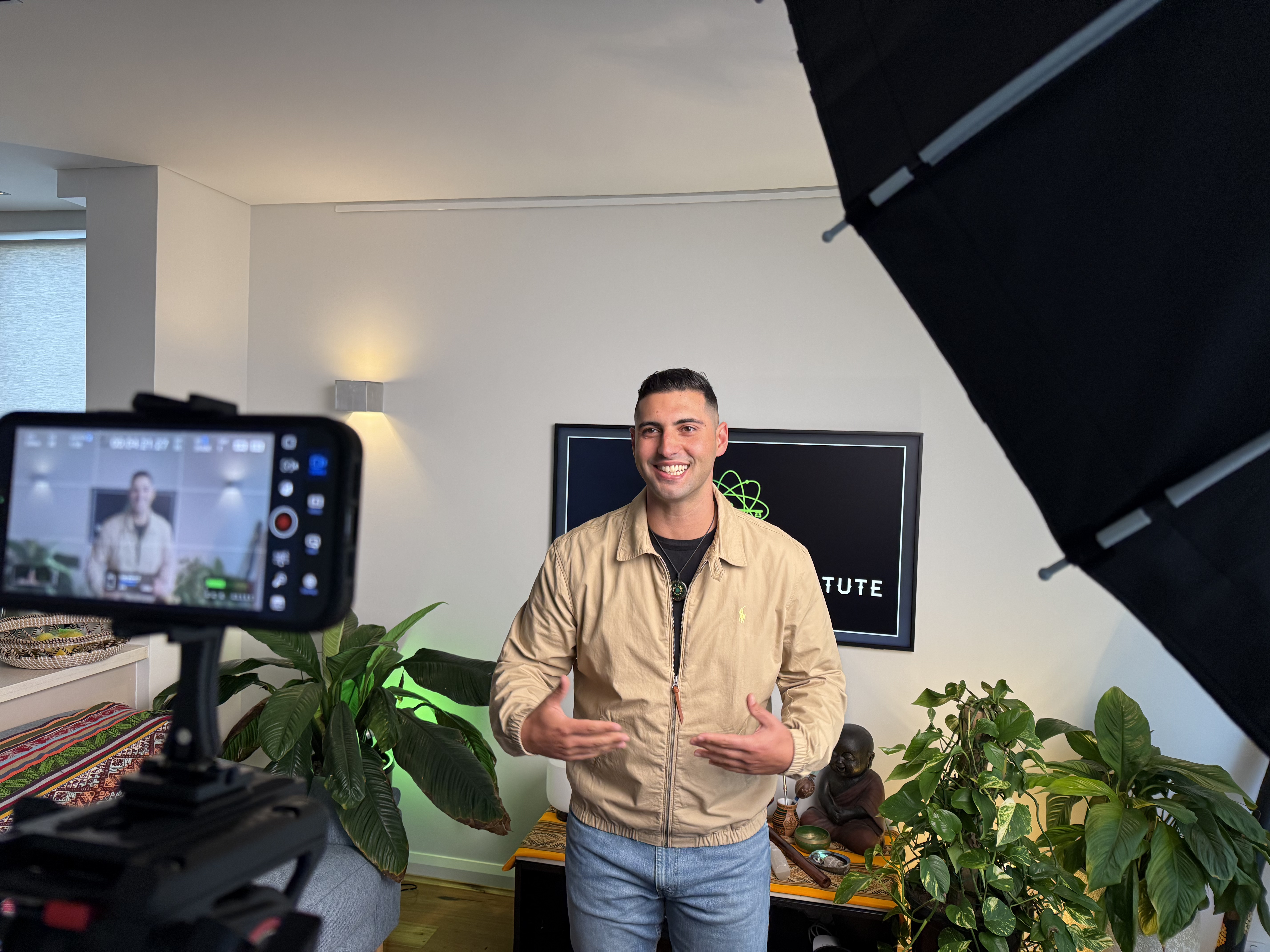
The first thing people notice about Luke Stringa is that he won't let you stay vague. The second thing is that his path here doesn't look like most people's in the coaching industry. He didn't come up through one school and stay in one lane. He came through five different worlds, each one of which added something he ended up folding into QKI.
This is the version with the actual story.
Chapter one: mechanical engineering.
Luke trained as a mechanical engineer. Most coaches in this industry don't start with a STEM degree. He did. What engineering taught him — before anything else — was how to think in systems. How things actually work. How parts fit together. How to trace a problem back to root cause rather than chasing symptoms.
He left engineering after a few years but the systems thinking stuck. It shows up now in how he architects programs, curricula, and the operations side of QKI. The Business Incubator is essentially a system — inputs, outputs, mechanisms in between — and the way it's structured reflects how he was originally trained to think.
Chapter two: IT.
From engineering he moved into IT. Different industry, same mindset. He learned how digital infrastructure runs, how to debug, how to build things that scale without breaking when you load them with more users or more demand.
The IT years did something else, too. They gave him early exposure to the online world that most coaches in his generation simply didn't have. He understood SaaS, hosting, web infrastructure, automation, and online business mechanics years before that knowledge became a coaching-industry asset. When he eventually moved into running businesses on the internet, the technical baseline was already there.
Chapter three: coaching and hypnotherapy.
The shift into coaching wasn't gradual. It was a specific decision. Luke trained as a coach and as a hypnotherapist and started taking clients. He ran an online practice for years, working one-to-one with clients on the kind of patterns that talk-based coaching alone can't shift — the subconscious work, the identity work, the things people came to him for after other approaches hadn't moved the needle.
The hypnotherapy training in particular gave him direct experience of what becomes a central QKM principle: most change happens at a level deeper than the conscious mind. Behaviour shifts when identity shifts. Trying to change behaviour while leaving identity untouched is why most coaching outcomes don't stick.
While he was doing this work, his brother Jacob was running parallel sessions on the breathwork, energy work and somatic side. The two of them would compare notes constantly. Those conversations were the early seeds of what eventually became the Quantum Key Method — the framework the brothers co-developed and the institute is now built around.
Chapter four: online sales and marketing.
To grow the coaching business he needed to learn how to actually market it. He went deep on online sales, marketing, content, and conversion. Not as theory — as the actual skill set required to fill his own calendar without burning out on social media.
The interesting thing is that he kept going past the point where he needed it for his own business. He got good enough at it that other coaches started asking him how he was doing it. The way they asked the questions made it clear there was a gap in the industry. Coaches were getting brilliant at the modality side and going broke on the business side.
Chapter five: the business side.
Luke spent years working on the operations side of established coaching businesses, learning what actually moved them and what didn't.
This is the experience that sits underneath the Business Incubator at QKI now. It's not theoretical. It's the same playbook he ran with paying clients for years before the institute existed:
- How to position a practitioner offer so clients say yes
- The actual mechanics of pricing premium services in a coaching market
- Content systems that bring the right clients in without grinding on social media
- Sales conversation frameworks that work without being pushy
- How to scale a one-person practice to a real business without losing the soul of the work
That work wound down in time for Luke to put his full attention into QKI. The skills came with him.
Chapter six: Quantum Key Institute.
The institute came out of years of conversations with his brother Jacob. Both of them had been doing parallel work with clients — Luke through coaching and hypnotherapy, Jacob through breathwork, energy work, hypnotherapy and meditation. The Quantum Key Method emerged out of years of both of them refining how they worked, comparing notes, and noticing the patterns that kept showing up across modalities.
It's important to be clear about this. The QKM wasn't invented by one of them. They developed it together. The decision when they built the institute was simple — Luke would take the business side, Jacob would take the practitioner training side, and both of them would teach the QKM itself.
QKI was built to fix the gap Luke had spent years watching from the inside: capable practitioners with brilliant gifts disappearing within twelve months because nobody had taught them the business side. The school combines all of it — the practitioner training Jacob leads and the Business Incubator Luke leads — into one program.
How Luke teaches inside QKI.
Direct. Specific. Allergic to fluff. The thing students bring up most often is that he won't let them stay vague — if they say "I want to help people", he'll ask which people, with what, for how much, by when. Not because the answer matters that day, but because the question is the work.
The other thing that comes up: he gets boring on purpose about the basics. Volume. Reps. Boring fundamentals done daily. He's said often that nobody in this industry fails from not knowing what to do. They fail from not doing the thing they already know.
The lines that stuck.
If you've been around the institute for any length of time, you've heard a few things Luke says often.
Outside the institute.
Luke is Australian. Most of his hours go into the business itself — building it, refining it, working on what's next. Outside of that he trains, swims in the ocean as often as he can, and is an unapologetic enthusiast for a good tiramisu. He's currently deep into AI research and integration — both inside QKI's own operations and as a service to QKI clients building their own practices. The brothers work together full time and are close.
If you want to connect with Luke directly: LinkedIn. Or follow QKI on Instagram, Facebook, and LinkedIn Company.
For Luke's full bio, read the Luke Stringa CEO page. For Jacob's side of the institute, see Jacob Stringa and the origin of the Quantum Key Method.